

What Material Is Used For The Clean Air Decal

Air conditioning isn't just expensive; it's besides terrible for the surroundings. Accounting for 10% of global energy consumption today, space cooling in 2022 alone was responsible for 1045 metric tons of CO2 emissions. This number is only expected to increase, with the International Energy Agency estimating that cooling will reach 37% of the earth's total energy demand past 2050.
 + x
+ x


Air-conditioning units are in item harmful because they rely on a refrigerant chosen Hydrofluorocarbon (HFC). While HFC only accounts for 1% of all greenhouse gas emissions, it is also thousands of times more potent than carbon dioxide.

Designing with materials that are naturally cooling can help mitigate these environmental effects past reducing the demand for air-conditioning. Below, we compile some material and structural solutions to passive cooling that may help designers regulate edifice temperatures energy-efficiently.
Thermal Mass and Insulation
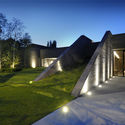
Dumbo materials such as stone, physical, and world each have a number of properties that allow them to act as good insulation from oestrus. These alternately include proficient thermal electrical conductivity (ability to rerelease passive cooling), thermal lag (tedious heat transmission), low reflectivity (lower redistribution of heat), and high volumetric heat capacity (elevated ability to store estrus). When such materials are used in bulk, their insular qualities go especially potent, exemplified past unique 'cave homes' such as Kapsimalis Architects' Summer Cave Firm in Santorini. Other projects, like A-cero's Concrete House II, rely on thick concrete walls to achieve similar effects.

More traditional homes may not employ such bulky materials simply rely on effective thermal insulation instead. Typically, the thermal resistance of insulation is measured by what is called the 'R-factor' or 'R-value.' The college this value, the more than thermally resistant the fabric, and the more effective of an insulator it is. Materials such as polystyrene, polyurethane foam, and phenolic cream are examples of thermal insulators that have phenomenally high R-values.

Natural Materials
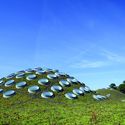
Besides its thick concrete walls, A-cero'due south Concrete House II and a multitude of similarly heat-conscious designs apply natural elements such as green roofs or ivy walls. Dark-green roofs are not only aesthetically pleasing, merely they also provide shade, remove oestrus from the air, and reduce the temperature of the roofs. Some notable examples include Renzo Piano'due south California University of Sciences, CPG's Nanyang School of Art, and Enric Ruiz-Geli's Villa Bio.

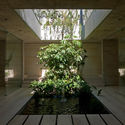
Incorporating water into a building tin besides cool a home through evaporation and air flow, depending on the climate. This methodology was recognized as early as the Romans, who often designed their homes around a fundamental courtyard pool.

Window Material and Placement
Green roofs and water features may seem excessive to the average homeowner or designer, merely passive cooling can likewise be as easy as choosing the right glass for a building'due south windows. The lower the solar heat gain coefficient (SHGC) of the drinking glass, the less heat it transmits and the cooler the building. These benefits can exist increased with external blinds, which prevent sunlight from hitting the windows at all and thus reduce the corporeality of heat or glare that reaches the interior. Even the positioning of these windows can have passive cooling furnishings through cross-ventilation, or the aligning of windows to facilitate air circulation. Notable examples of cantankerous-ventilation include Louisiana shotgun houses, which minimize interior walls that may obstruct horizontal drafts.

Covering
Lastly, light-colored reflective roofs, another alternative to dark-green roofs, can finer absurd interiors by redirecting sun rays and decreasing heat absorption. Examples include roofs with sheet coverings, reflective tiles or shingles, or reflective paint. While standard or nighttime roofs tin can reach 150 degrees Fahrenheit in intense heat, 'cool roofs' may only achieve l under the same conditions.

High roofs and cupolas may likewise allow existing oestrus to rise and escape areas in use. Similarly, covered porches and awnings can protect interiors from sunlight and glare. Altogether, material considerations and structural blueprint go hand in hand to create effective alternatives to ac and mechanical cooling, decreasing HFC use and detrimental greenhouse gas emissions.
Cite: Lilly Cao. "What Materials Go on Buildings Cool?" 26 Aug 2022. ArchDaily. Accessed . <https://world wide web.archdaily.com/923445/what-materials-keep-buildings-cool> ISSN 0719-8884

Source: https://www.archdaily.com/923445/what-materials-keep-buildings-cool
Posted by: thompsonprien1967.blogspot.com
0 Response to "What Material Is Used For The Clean Air Decal"
Post a Comment